

Welcome to the fundamental world of early childhood education. The transition from simple counting to addition is a crucial milestone in a child’s cognitive development. This guide is designed to help parents and educators support this process using preschool worksheets and evidence-based strategies, ensuring that math is fun and accessible for all children. We will answer questions such as…
Is Using Fingers a Bad Habit?
In many traditional school education settings, children were once discouraged from using their fingers. However, modern research suggests that “finger-based representations” are actually vital for developing number sense. By using fingers, a physical link is created between a concrete quantity and an abstract numeral.
When addition math sheets are introduced, fingers act as a built-in “manipulative.” This tactile feedback is essential in special education and mainstream classrooms alike. Rather than being viewed as a “crutch,” finger counting should be seen as a necessary bridge. Eventually, as fluency is gained through addition activity sheets, the reliance on fingers will naturally fade as the child moves toward mental math.
“They Can Count, But Not Add”—What is Happening?
It is often observed by parents that a child can recite numbers up to 100 perfectly, yet struggles when asked “what is 2 plus 3?” This occurs because counting is often learned as a rote sequence, similar to the alphabet, whereas addition requires an understanding of “cardinality”—the concept that the last number counted represents the total quantity of the set.
To remedy this, kg activity sheets should focus on “counting on.” If a child has three apples and is given two more, they should be encouraged to start at three and say “four, five,” rather than restarting from one. This skill is frequently reinforced in happy numbers programs and high-quality kdg worksheets.
The Mystery of Zero
The concept of “nothing” is surprisingly complex for a young mind. In math addition worksheets, the number zero is often misunderstood as a “magic” number that makes things disappear, or it is simply ignored.
It must be explained that zero represents an empty set. When addition worksheets for grade 1 are utilized, including problems like 5+0=5 is crucial. It should be demonstrated that adding zero means the original quantity remains unchanged. Using free kindergarten worksheets that feature empty baskets or boxes can visually solidify this abstract idea.
Checklist: Is Your Learner Ready for Addition Up to 20?
Before moving on to more complex math worksheets, ensure the following milestones have been met:
- Can the child subitize (identify the number of objects in a small group without counting)?
- Is the concept of “one more” understood?
- Can sums of 10 (e.g., 7+3, 6+4) be identified quickly on kindergarten activity sheets?
- Is the “plus” and “equals” signage recognized consistently?
Below, access is provided to a specialized variety of super worksheets tailored for early childhood education. These kdg worksheets focus on the “mystery of zero” and “counting on” techniques to ensure no learner is left behind. Simply click the links to download the addition activity sheet PDFs and begin transforming abstract numbers into concrete skills today.
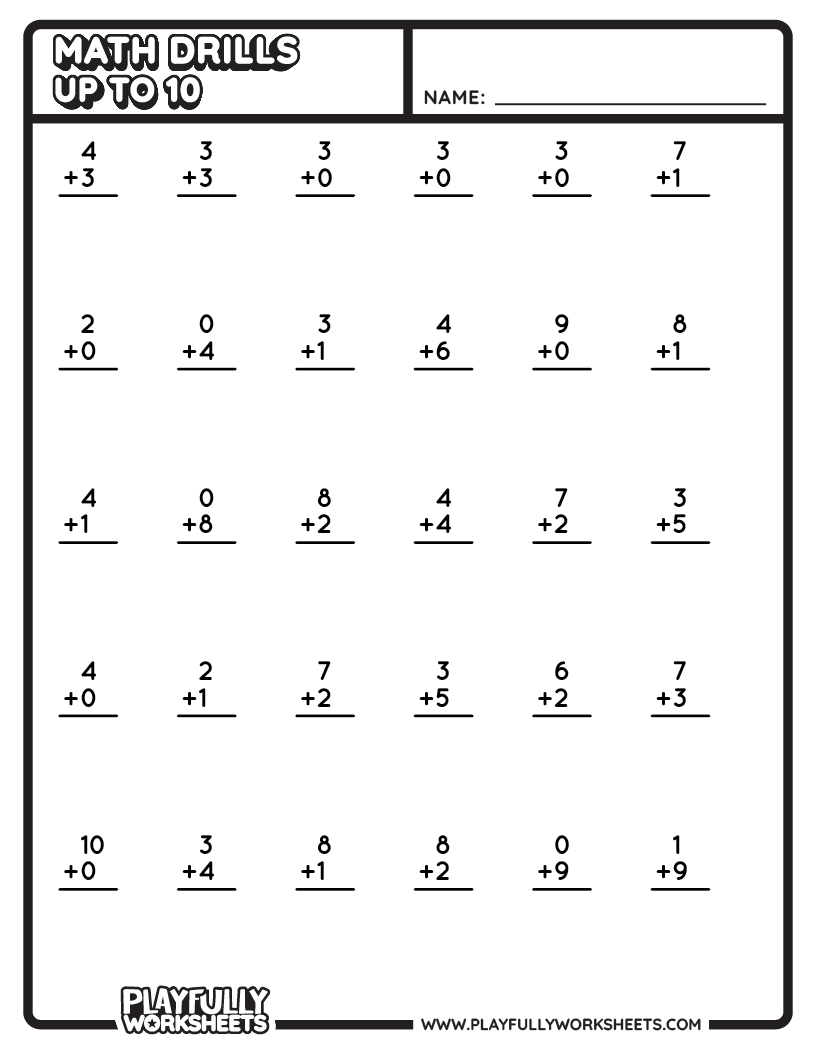
30 Addition Facts Within 10 (Starter Drill) – Level 1
Perfect for beginners just starting their math journey. This 30-problem drill focuses on building confidence and basic recognition of sums up to 10. The spacious layout is ideal for younger learners who need extra room to write their answers clearly
Option 2
Option 3
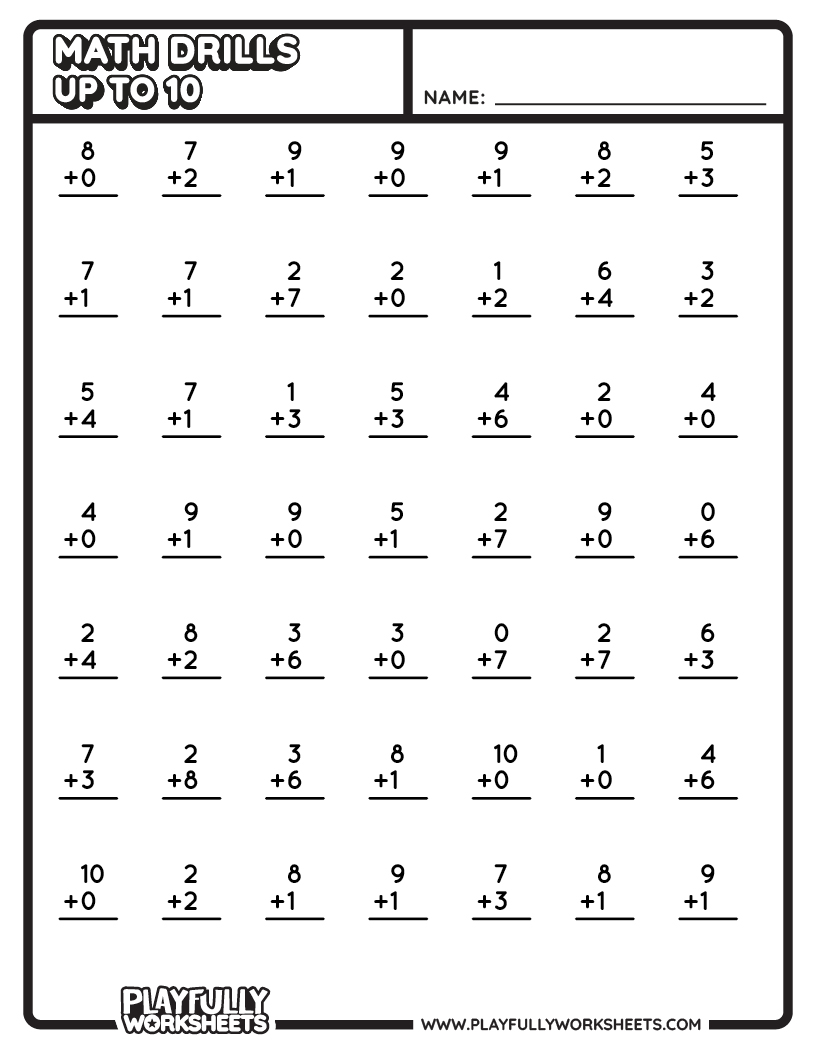
49 Addition Facts Within 10 (Intermediate Drill) – Level 2
Take the next step in math fluency with our 49-problem practice sheet. This drill bridges the gap between basic counting and automatic recall. It’s the perfect length for a daily warm-up or a quick classroom assessment to track progress.
Option 2
Option 3
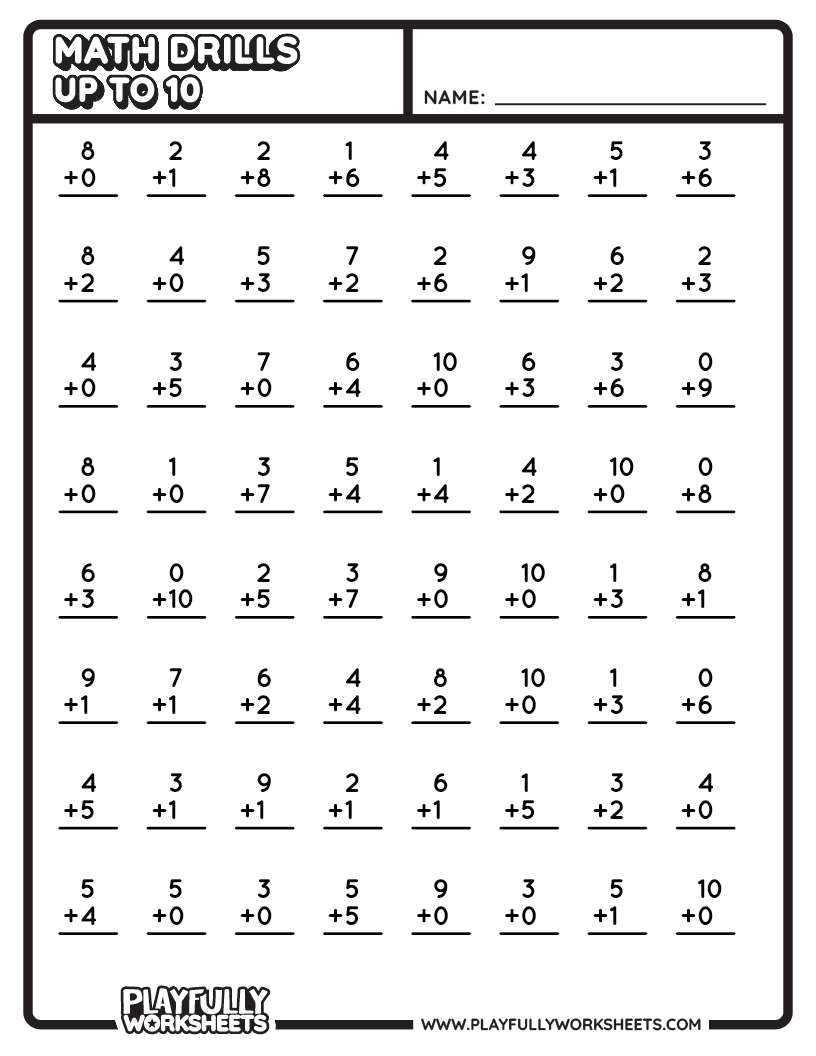
64 Addition Facts Within 10 (Advanced Drill) – Level 3
Ready for a challenge? This 64-problem worksheet is designed to improve speed and mental stamina. By increasing the volume of operations, students strengthen their ability to solve addition facts quickly and accurately without getting overwhelmed.
Option 2
Option 3
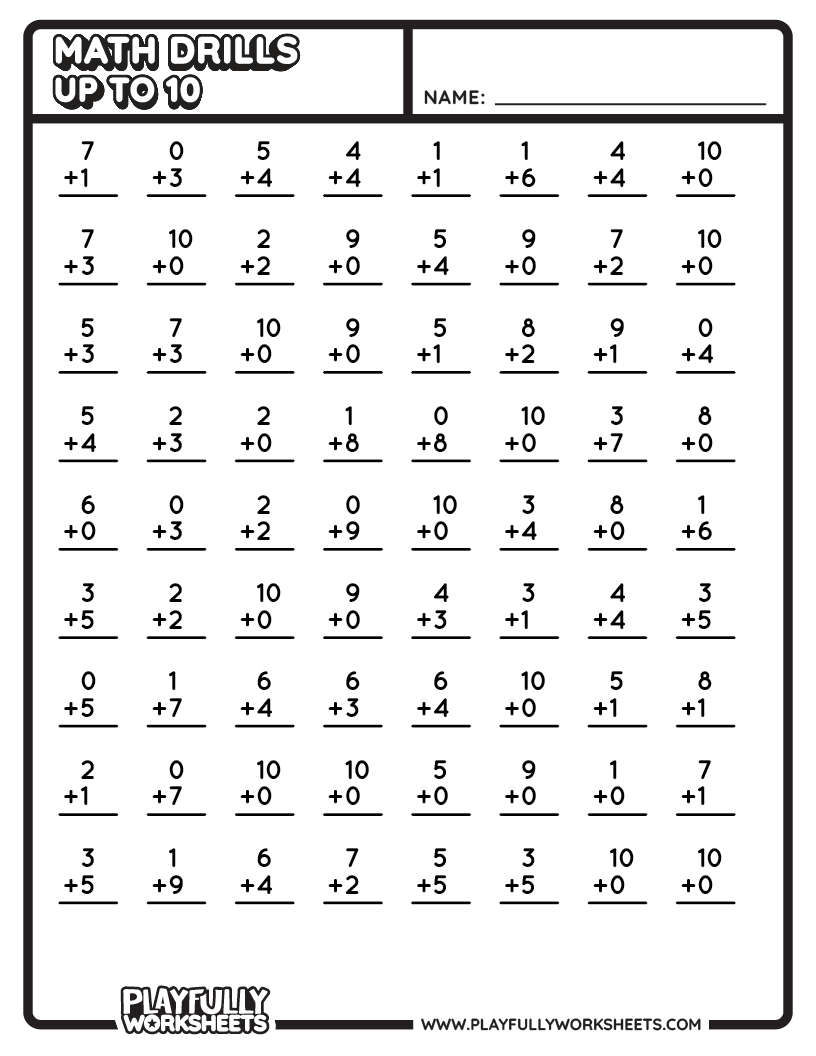
72 Addition Facts Within 10 (Mastery Drill) – Level 4
The ultimate test for math mastery! Our 72-problem drill is perfect for students aiming for total fluency in addition within 10. This high-density worksheet is an excellent resource for timed tests, helping learners achieve lightning-fast recall of every basic sum.
Option 2
Option 3