

As students progress through school education, the leap from single-digit sums to addition up to 20 introduces new challenges, such as place value and “teen” numbers. This phase of early childhood education requires a shift from simple counting to strategic thinking. By using targeted addition and subtraction worksheets, we can foster a deeper mathematical intuition.
Memorization vs. Understanding
A common debate in special education and general classrooms is whether math facts should be memorized or understood through strategy. While fluency is the goal, it is widely accepted that understanding must come first. When math addition worksheets are used merely for rote memorization, children often lose the ability to self-correct. Conversely, when strategies are taught, a child can “find” the answer even if they forget the fact. Math is fun when it feels like a puzzle to be solved rather than a list to be memorized.
The 12 vs. 21 Confusion: Understanding Reversals
It is frequently noted that children often confuse 12 and 21. This is rarely a sign of a learning disability; rather, it is a misunderstanding of place value. In English, the “teen” numbers are linguistically confusing (we say “four-teen” but write the 1 first). Using addition worksheets that emphasize “ten and some more” helps clarify that 12 is 10+2, whereas 21 is two tens and a one.
Technique 1: “The Big Number in Your Head”
One of the most effective strategies found in addition activity sheets is the “Counting On” method. Instead of starting from one, the child is taught to identify the larger addend and “keep it in their head.” For 4+12, the child starts at 12 and counts “13, 14, 15, 16.” This reduces the cognitive load and is a staple in addition worksheets for grade 1.
Technique 2: The Power of “Doubles”
The “Doubles” strategy is a favorite in happy numbers curricula. Most children find it easier to remember 6+6=12 or 8+8=16. These are known as “anchor facts.” Once these are mastered, “Near Doubles” can be introduced. For example, if 6+6=12, then 6+7 must be 12+1=13. This logic-based approach is highly encouraged in kdg worksheets.
Technique 3: The Double Ten Frame
The Double Ten Frame is a visual tool used extensively in free kindergarten worksheets. It consists of two grids of ten spaces. To solve 8+6, the child fills 8 spaces in the first frame and 6 in the second. They then “move” two from the second frame to fill the first. This visually demonstrates that 8+6 is the same as 10+4.
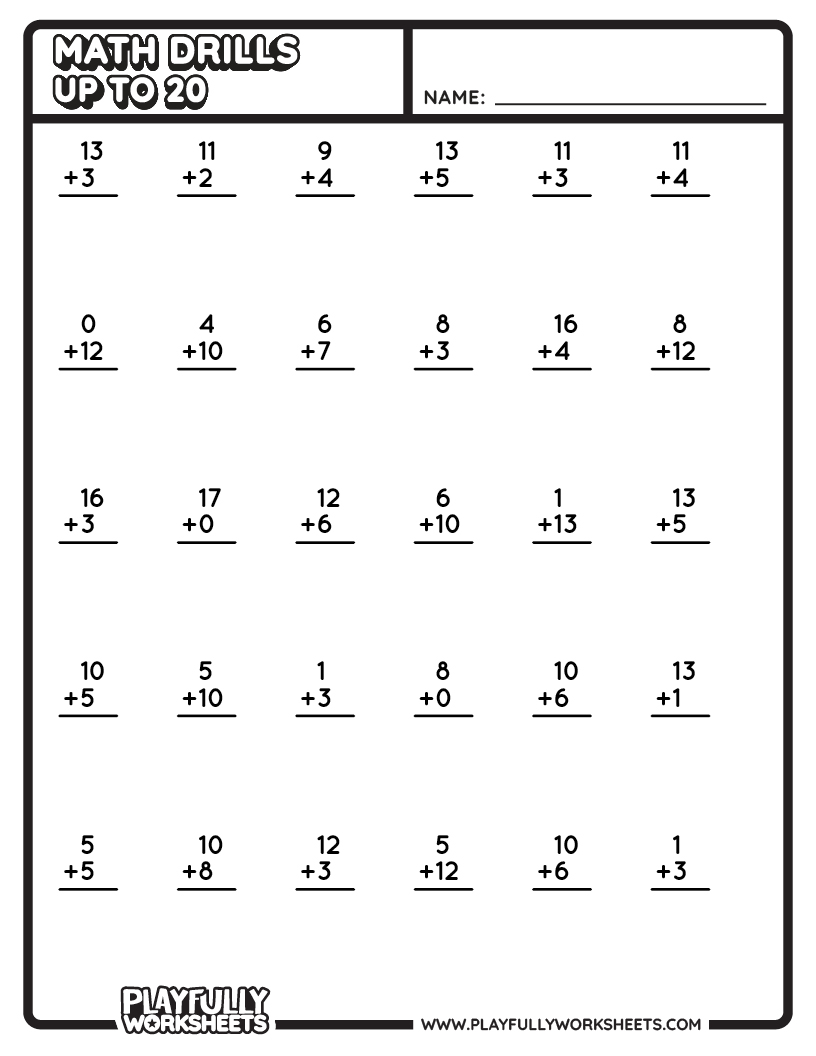
30 Addition Facts Within 20 (Bridge to Fluency)
Introduce your students to larger sums with this introductory 30-problem drill. This worksheet focuses on bridging the gap between basic sums and ‘teen numbers,’ providing a comfortable pace for learners to master addition up to 20 without feeling rushed.
Option 2
Option 3
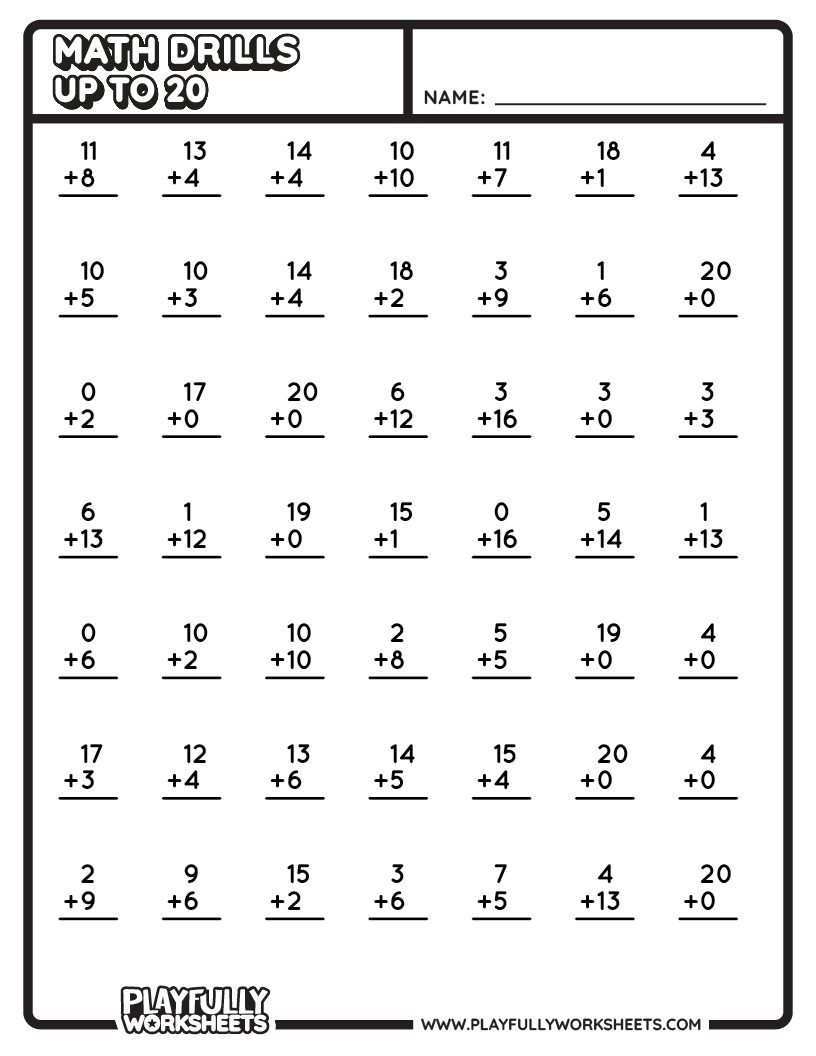
49 Addition Facts Within 20 (Skill Builder)
Build consistency and accuracy with our 49-problem practice sheet. This intermediate drill is specifically designed to reinforce mental math strategies, helping students become more comfortable with double-digit results and strengthening their overall numerical fluency.
Option 2
Option 3
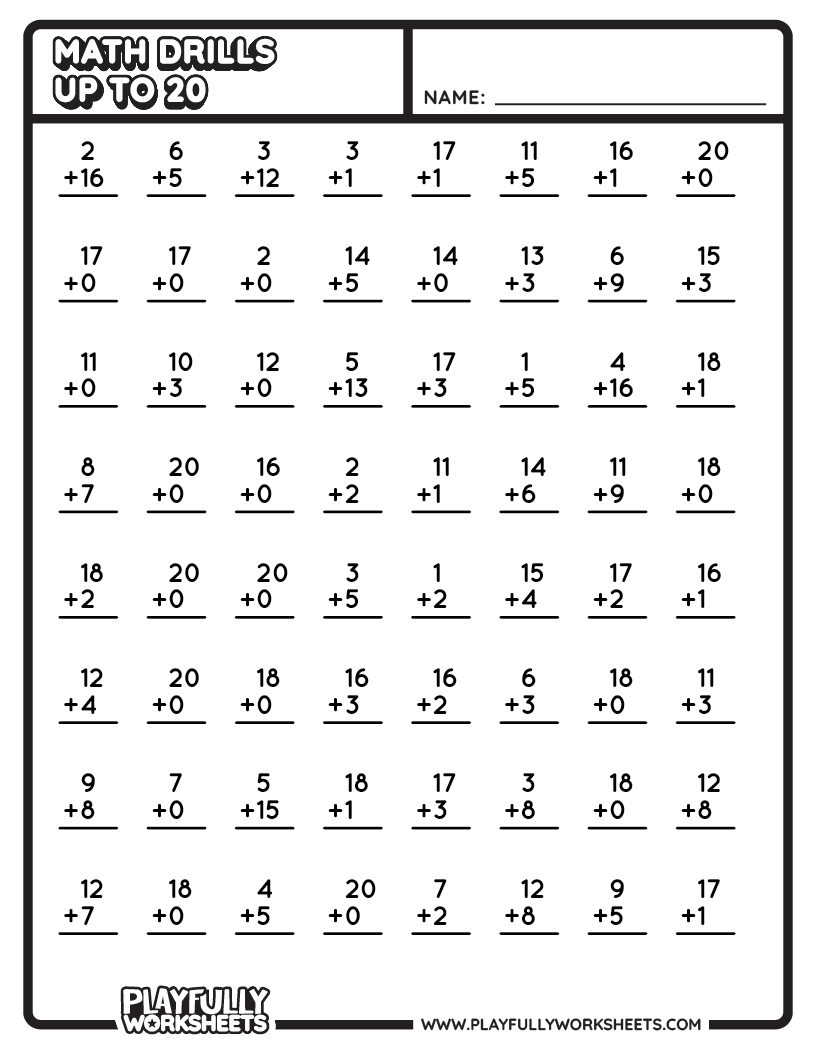
64 Addition Facts Within 20 (Speed Challenge)
Push beyond the basics! This 64-problem worksheet is perfect for developing the mental stamina required for more complex math. It challenges students to recall addition facts quickly, making it an ideal resource for daily practice or timed classroom drills.
Option 2
Option 3
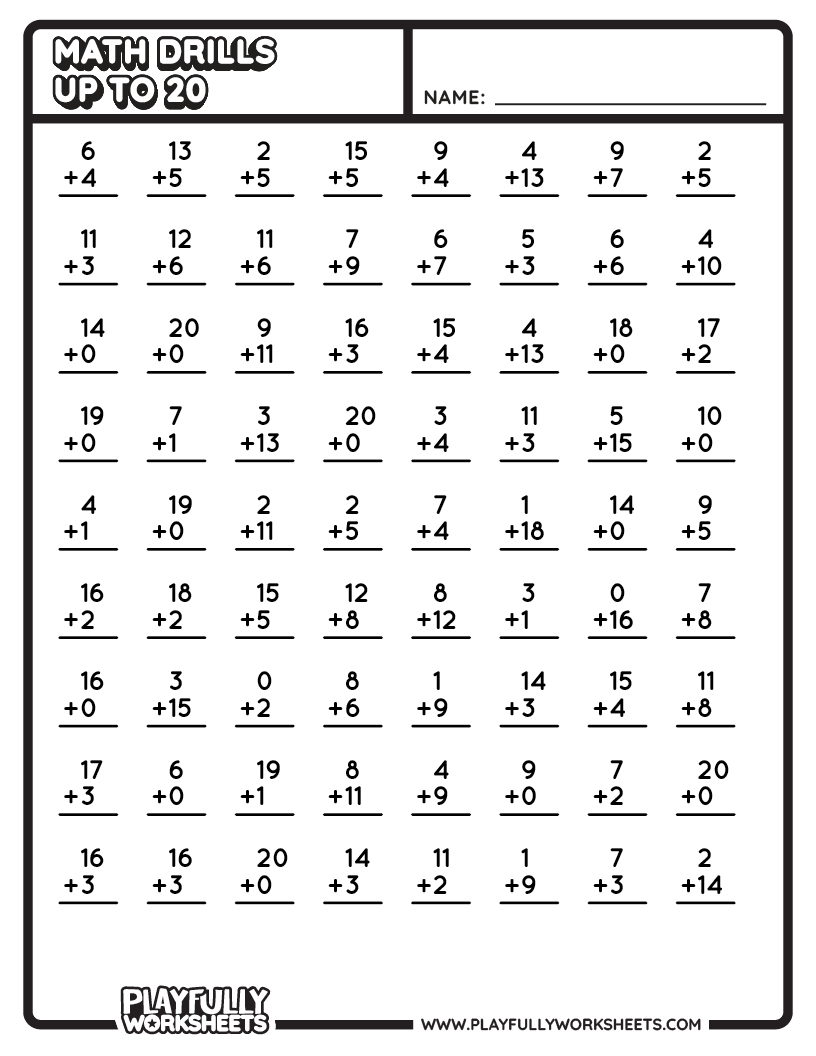
72 Addition Facts Within 20 (Pro Mastery)
The comprehensive workout for math pros. With 72 problems per page, this mastery drill ensures that students have fully internalized addition facts within 20. It is the ultimate tool for achieving total automaticity and preparing for more advanced subtraction and regrouping.
Option 2
Option 3