


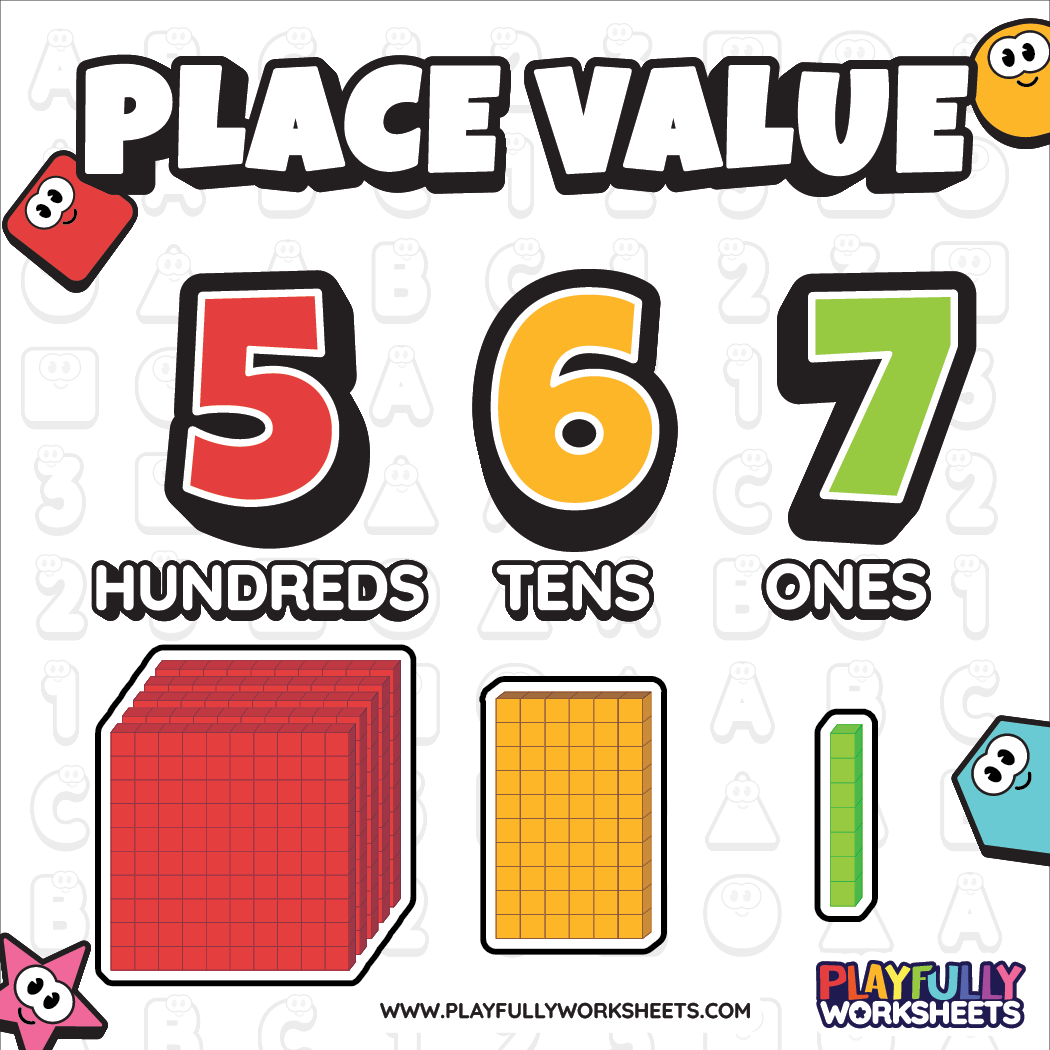
Place value is the concept that the value of a digit in a number depends on its position — not just the digit itself. For example, the number 3 means something completely different in 35 than it does in 350 or 3,000. Understanding place value is one of the most important foundations in elementary math, and place value worksheets are one of the most effective tools for helping children build that understanding step by step.
Furthermore, place value is not a single lesson — it is a concept that grows with a child from kindergarten all the way through upper elementary. As a result, a solid grasp of place value makes addition, subtraction, multiplication, and even decimals significantly easier to learn.
Why Place Value Matters for Kids
Place value is the backbone of the entire number system. Without it, numbers are just symbols. With it, children understand why 47 is bigger than 38, how carrying works in addition, and what it actually means to multiply by ten. In short, every math operation a child will ever learn is rooted in place value.
Place value is introduced as early as kindergarten through basic tens and ones concepts, and it becomes more complex with each grade. By 2nd grade, children are working with hundreds. By 3rd and 4th grade, thousands and ten-thousands are introduced. Moreover, when decimals enter the picture in 4th and 5th grade, place value extends in the other direction — to tenths, hundredths, and beyond.
Children who struggle with place value often find addition with regrouping, subtraction with borrowing, and multi-digit multiplication confusing — not because those operations are hard, but because the foundation beneath them is shaky. Therefore, building this concept early and clearly makes a significant difference across all areas of math.
Place Value Explained — From Ones to Millions
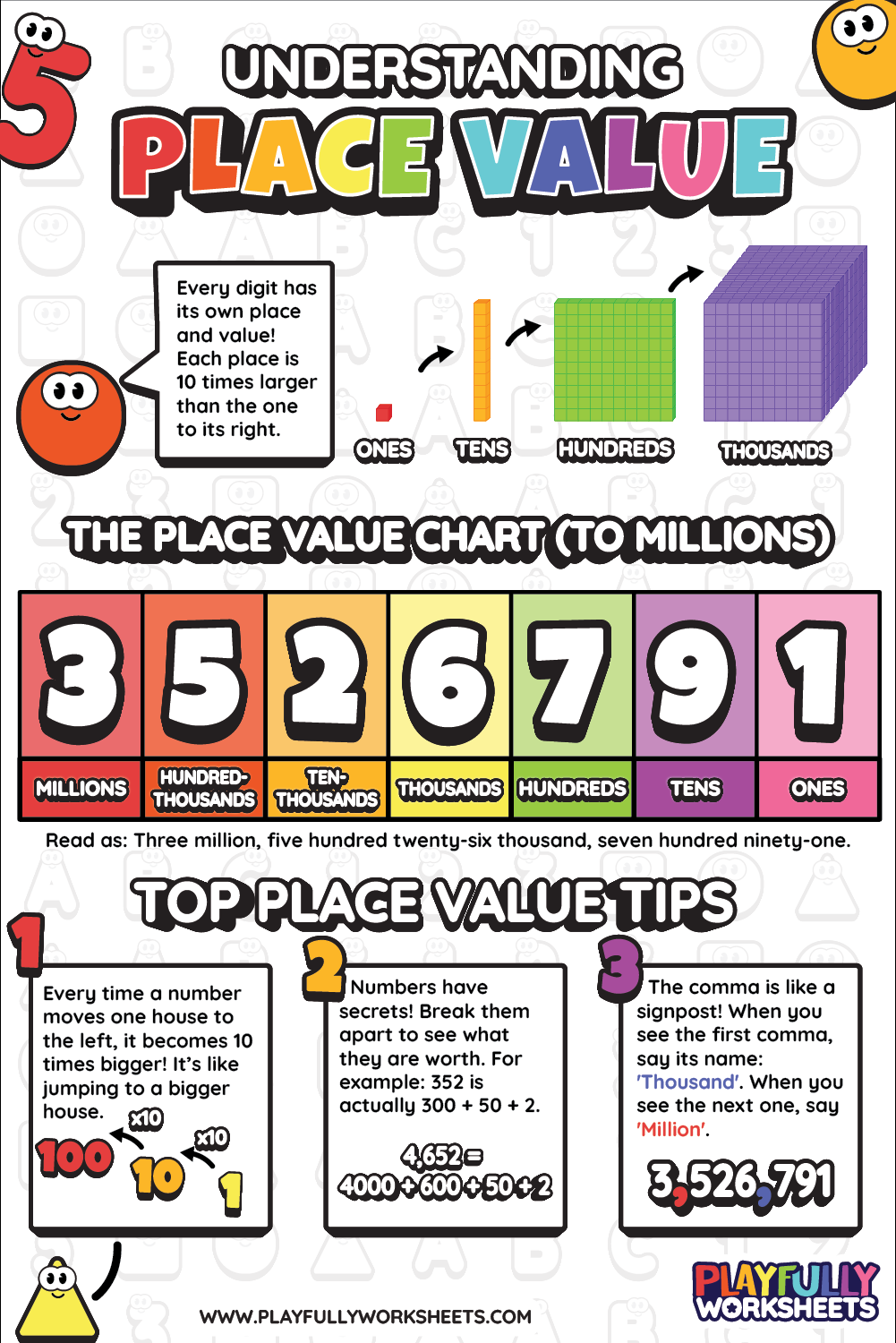
The easiest way to understand place value is to look at how positions are organized from right to left in a whole number. Each position has a name and a value that is ten times greater than the one to its right.
Ones — the rightmost digit. In the number 247, the 7 is in the ones place. It means exactly 7.
Tens — the second position from the right. In 247, the 4 is in the tens place. It means 4 tens, or 40.
Hundreds — the third position. In 247, the 2 is in the hundreds place. It means 2 hundreds, or 200.
So 247 = 200 + 40 + 7. This way of breaking a number apart is called expanded form, and it is one of the most commonly practiced place value skills in elementary school.
The pattern continues: Thousands, Ten-Thousands, Hundred-Thousands, Millions — each position ten times larger than the one before it.
Place Value with Decimals
Place value does not stop at the ones position — it continues to the right of the decimal point as well. The positions to the right of the decimal follow the same logic but in the opposite direction, each one ten times smaller than the one to its left.
- Tenths — one position to the right of the decimal. In 3.7, the 7 is in the tenths place and means 7 tenths, or 0.7.
- Hundredths — two positions to the right. In 3.74, the 4 is in the hundredths place and means 4 hundredths, or 0.04.
- Thousandths — three positions to the right. In 3.742, the 2 means 2 thousandths, or 0.002.
Understanding decimal place value is essential for rounding, comparing decimals, and working with money — all skills introduced in 4th and 5th grade.
Tips for Parents and Teachers
1. Start With Hands-On Objects
Before pencil and paper, place value is best understood through physical objects. Blocks, coins, or even dried beans grouped into tens and ones make the abstract idea concrete. For instance, showing a child ten loose pennies and then exchanging them for a dime is a powerful place value lesson that connects directly to real life.
2. Use a Place Value Chart
A place value chart is a simple grid that shows each position labeled from ones to millions (or tenths to thousandths for decimals). Children can write digits in the correct columns to build numbers visually. Furthermore, a laminated chart kept at a child’s workspace becomes a reference they naturally reach for during math practice.
3. Practice Expanded Form Regularly
Writing numbers in expanded form — breaking 583 into 500 + 80 + 3 — is one of the clearest ways to reinforce what each digit actually means. This skill is practiced extensively in 2nd and 3rd grade and is directly connected to addition and subtraction with regrouping. Therefore, including expanded form exercises in regular worksheet practice is highly recommended.
4. Compare Numbers Using Place Value
Asking a child “which is bigger — 456 or 465?” is a great place value exercise. The answer requires comparing the tens digit, which means the child must understand what each position represents. In addition, this kind of comparison builds number sense and prepares children for ordering and sequencing activities.
5. Connect Place Value to Operations
Place value becomes most meaningful when children see how it connects to the math they are already doing. For example, when practicing addition worksheets, point out that carrying a “1” to the next column is really moving ten ones into the tens place. This connection between place value and operations makes both concepts click faster.
Free Place Value Worksheets
Our free place value worksheets are coming soon. Bookmark this page to be the first to know when they are available!
In the meantime, explore our other math worksheets that connect closely to place value — including addition and subtraction, where place value is applied directly in every problem.
Place Value Charts
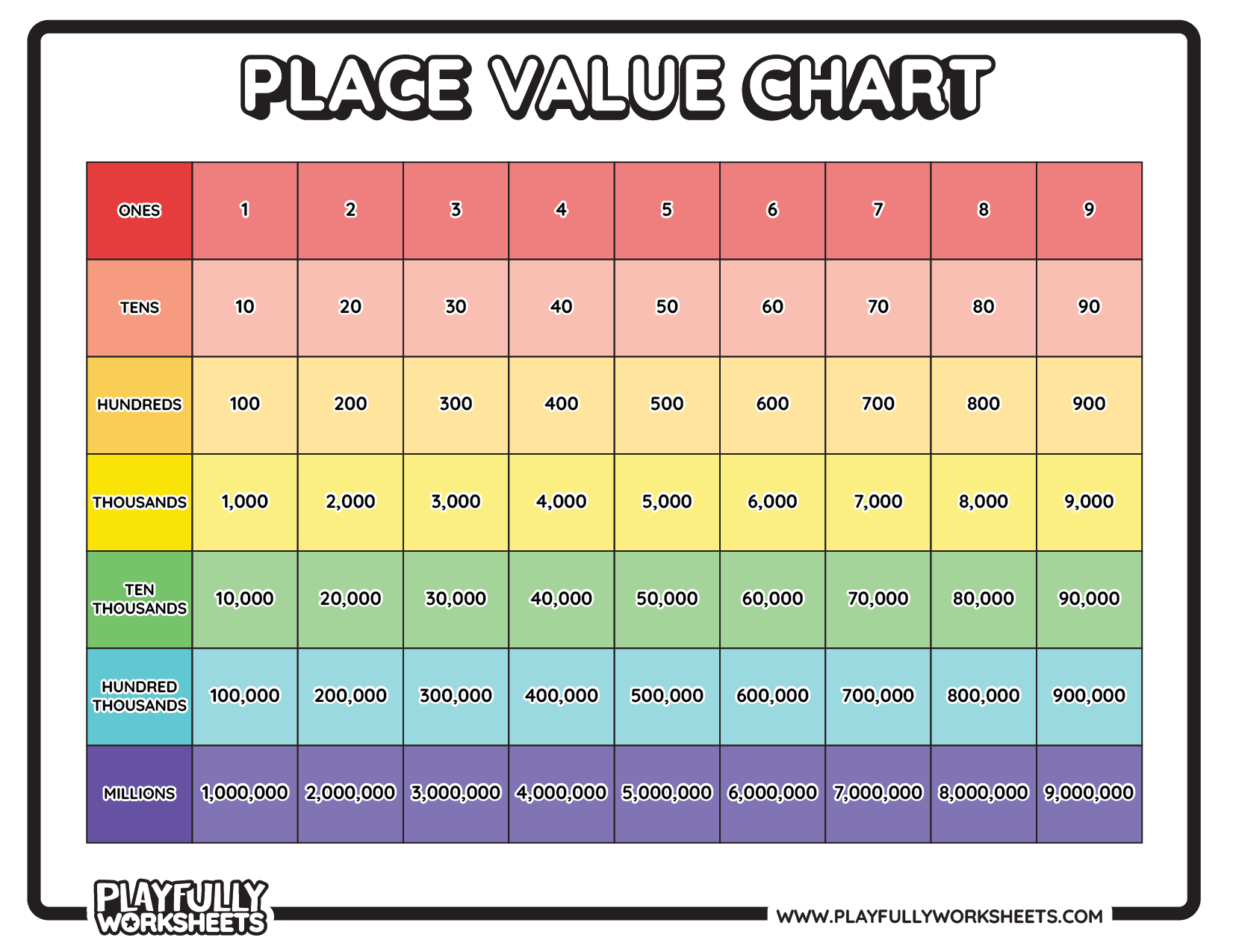
This vibrant, color-coded Place Value Chart is an exceptional educational resource designed to help elementary and middle school students master the concepts of whole numbers up to the millions period.
Featuring a clear grid layout, the chart organizes mathematical values into row-by-row tiers including Ones, Tens, Hundreds, Thousands, Ten Thousands, Hundred Thousands, and Millions.
Place Value Charts with Decimals
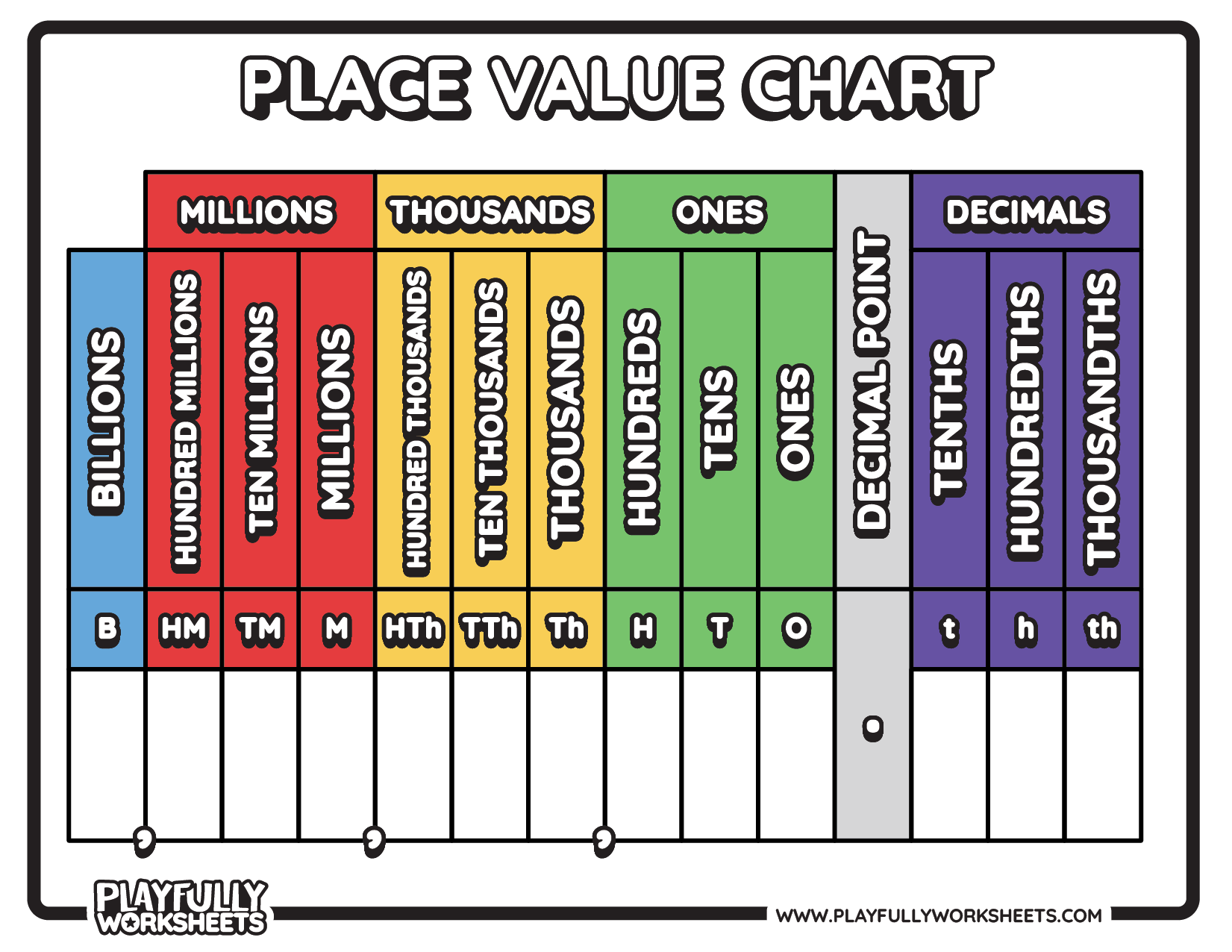
his professional and highly structured Place Value Chart with Decimals is the ultimate educational tool for teaching students the full spectrum of numerical values, bridging the gap between massive integers and precise fractional parts.
The chart features a clean vertical column layout that spans from Billions on the far left all the way to Thousandths on the right, neatly separated by a prominent, dedicated column for the Decimal Point.
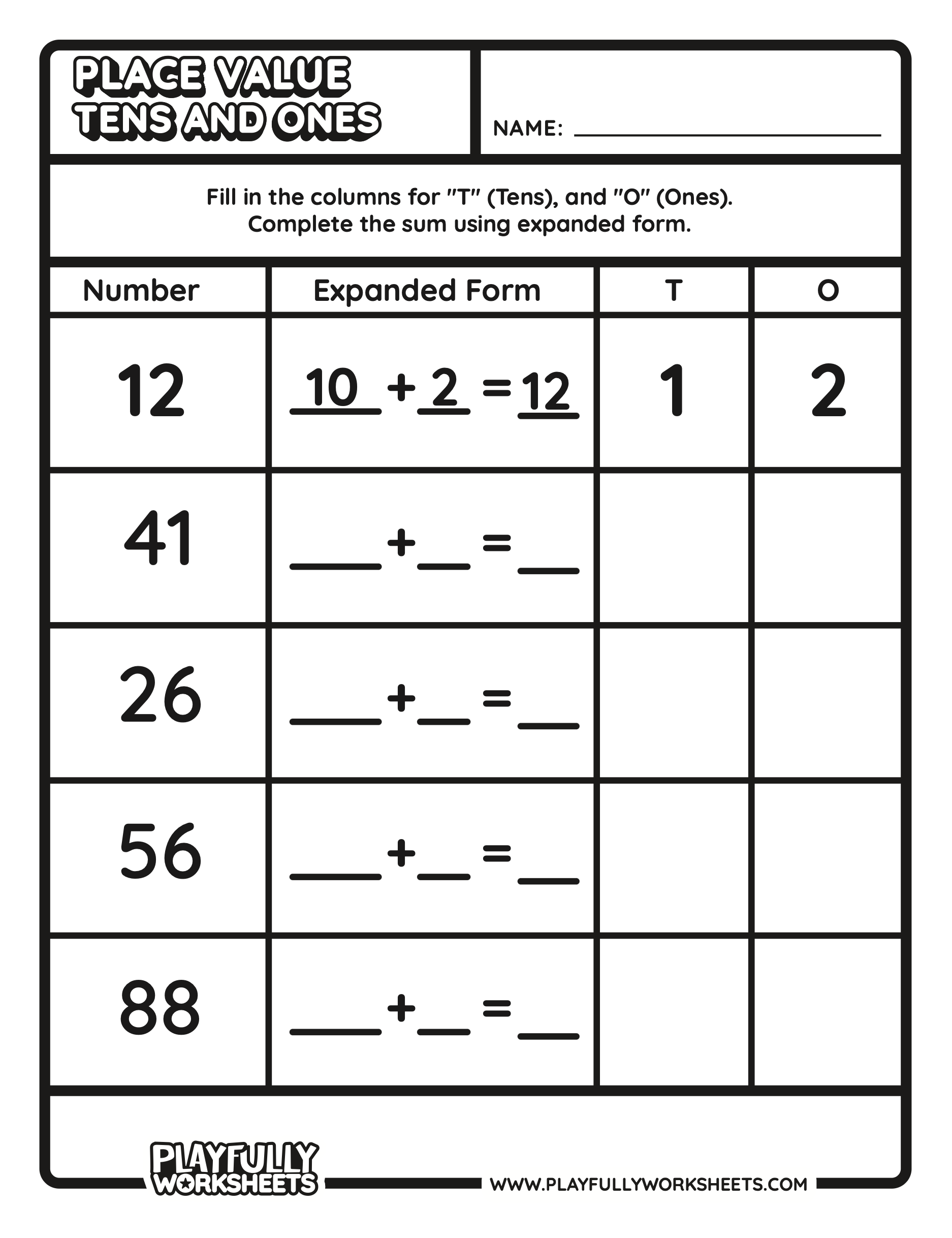
Place Value Tens to Ones
Master double-digit numbers with our “Tens and Ones” worksheets. Students practice breaking down numbers into expanded form (40+1=41) while filling out “T” and “O” columns.
These free PDFs help kids visualize number composition. They are the perfect resource for building a strong math foundation in early elementary grades.
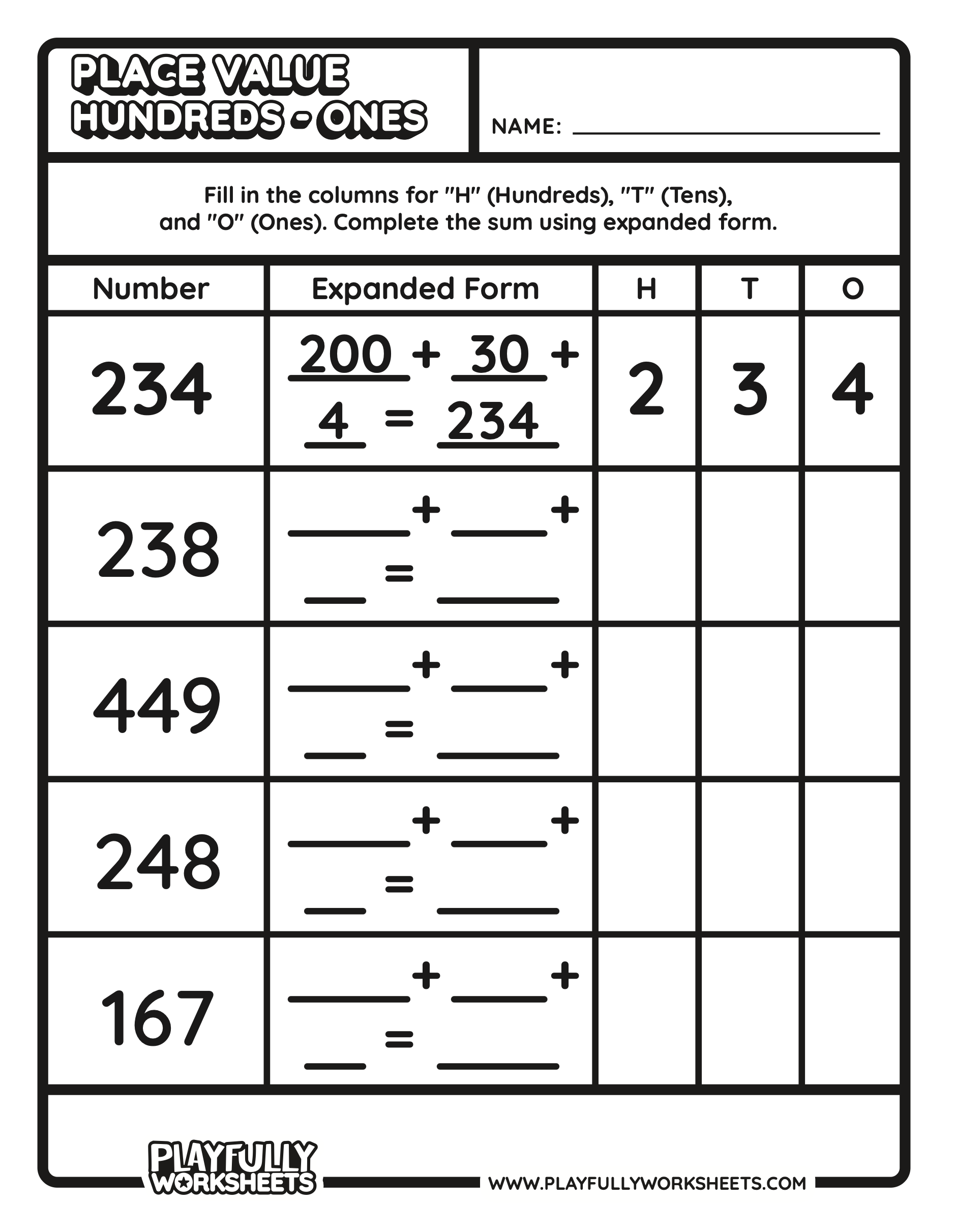
Place Value Hundreds to Ones
Take math further with our “Hundreds, Tens, and Ones” worksheets. These activities guide students through three-digit numbers, emphasizing the specific value of every digit.
Use expanded notation and charts to master numbers up to 999. These printable PDFs are ideal for classroom drills or at-home math reinforcement for growing learners.
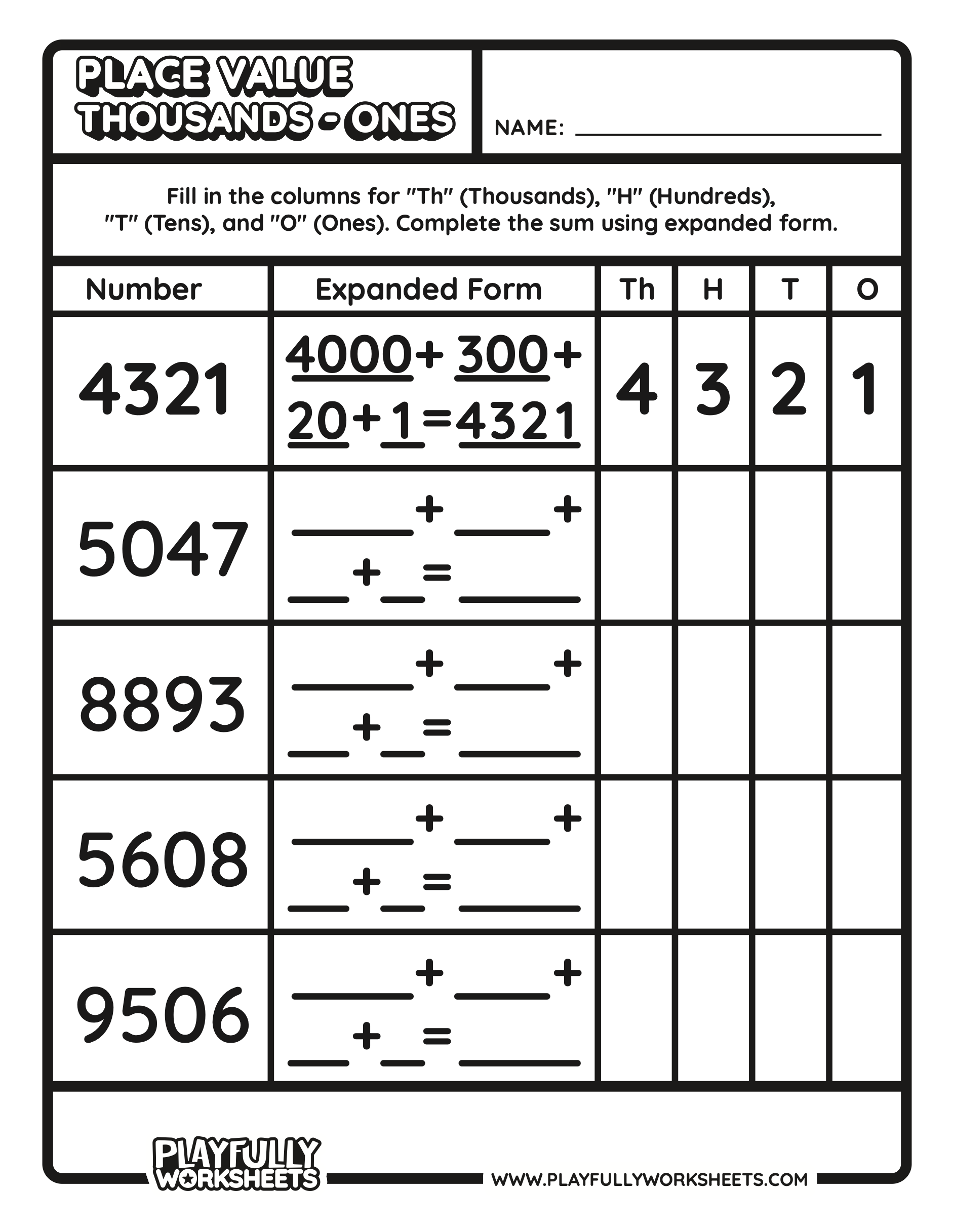
Place Value Thousands to Ones Example
Challenge students with “Thousands to Ones” place value practice. These worksheets focus on four-digit numbers, teaching kids to identify thousands, hundreds, tens, and units accurately.
Build confidence with larger numbers through clear expanded form exercises. Download these free math PDFs to support advanced place value mastery in higher elementary grade levels.
Frequently Asked Questions
Q: What is place value in simple terms? A: Place value means that the position of a digit in a number determines its value. The digit 4 means something different in 40, 400, and 4,000 — its value depends entirely on where it sits within the number.
Q: When do kids learn place value? A: Place value is introduced in kindergarten and 1st grade through basic ones and tens concepts. It expands to hundreds and thousands in 2nd and 3rd grade, and to decimals in 4th and 5th grade. The concept is revisited and deepened at every level.
Q: What is a place value chart? A: A place value chart is a visual tool that organizes number positions into labeled columns — ones, tens, hundreds, thousands, and so on. Digits are written in the correct column to show their value. It is one of the most widely used tools for teaching and practicing place value at the elementary level.
Q: What is expanded form? A: Expanded form is a way of writing a number that shows the value of each digit separately. For example, 472 written in expanded form is 400 + 70 + 2. This practice makes place value visible and is commonly introduced in 2nd grade.
Q: How does place value connect to decimals? A: The same system that applies to whole numbers extends to the right of the decimal point. Just as the tens place is worth ten times the ones place, the tenths place is worth one-tenth of the ones place. Understanding this connection is essential for working with money, measurement, and rounding in upper elementary grades.
Final Thoughts
Place value is one of the most important concepts in all of elementary math — and it is one that is built gradually, grade by grade. When children truly understand that every digit has a position and that position gives it meaning, the rest of math begins to make far more sense. Furthermore, a strong place value foundation makes skills like addition, subtraction, multiplication, and decimals much easier to learn and apply.
Explore our free place value worksheets and help your child build one of the strongest foundations in elementary math. For more connected math practice, check out our full collection of math worksheets.