

CVCe words, often called “magic e” words, are the building blocks that help children transition from simple decoding to more fluent reading. The term CVCe stands for Consonant–Vowel–Consonant–silent e, and this tiny letter at the end of a word has a huge impact. It transforms the vowel sound from short to long, turning cap into cape, kit into kite, and hop into hope. Understanding this simple rule gives children the ability to unlock hundreds of new words, making reading feel less like memorization and more like discovery.
Introducing CVCe words is essential in early childhood education because they bridge the gap between CVC words and more complex patterns. For parents and teachers, recognizing the importance of the silent e can guide instructional strategies. When children master these words, they gain confidence, fluency, and a sense of independence that encourages them to explore reading beyond worksheets or classroom assignments.
How the Silent “e” Changes Everything: A Simple Explanation for Parents
The silent e might look small, but it’s incredibly powerful. Although children do not pronounce it, this letter signals that the preceding vowel should sound long. Think of it like a little lamp shining on the vowel, highlighting its sound. When explained this way, children often grasp the concept more naturally. It turns what could feel like an abstract rule into something visual and memorable, helping them decode words with confidence.
Parents should remember that this rule, while useful, is not perfect. English has exceptions, but for early learners, understanding the general pattern is far more important than knowing every exception. By framing the silent e as a helpful friend rather than a tricky obstacle, children approach reading with curiosity instead of frustration. This perspective encourages a love of reading while reinforcing key phonics principles.
The Most Common CVCe Patterns Children Learn First
Children typically start with a handful of patterns that appear most frequently in early reading materials. Patterns such as a_e in words like cake, name, and same, or i_e in kite, ride, and time, are often introduced first. Similarly, the o_e pattern in home, rope, and hope, and the u_e pattern in cube, cute, and mule help children see predictable changes in vowel sounds. These patterns create a framework for decoding, making reading less overwhelming.
It is important to introduce these patterns gradually, according to the child’s readiness and the school curriculum. Some children may encounter i_e before a_e, depending on the resources used. By focusing on one pattern at a time, teachers and parents allow children to internalize the sound changes, making the transition to independent reading smoother and more successful.
The Biggest Challenges Kids Face When Learning CVCe Words
Despite their simplicity, CVCe words can present challenges. Young learners often read kit instead of kite, pronounce the silent e, or confuse long and short vowels. Some children may forget the rule when encountering new words or mix CVC and CVCe patterns during the transition. These mistakes are normal, but recognizing them early can prevent frustration and build stronger reading habits.
Another challenge is generalization. While a child may successfully read one a_e word, they might struggle with others in different contexts. Parents and teachers should provide multiple opportunities for practice and gently guide learners to notice the consistent patterns, using meaningful examples and repetition rather than rote memorization.
When Are Children Typically Ready for CVCe Words?
Children usually approach CVCe words after mastering CVC words and achieving automatic recognition of short vowels. They should have a solid foundation in blending sounds and decoding simple words independently. Typically, this readiness appears toward the end of kindergarten or during first grade, though every child progresses at their own pace.
Parents and teachers should look for signs of readiness, such as consistent accuracy with CVC words, fluency in reading short vowel sounds, and an eagerness to explore new words. Introducing CVCe words too early may lead to confusion, while introducing them too late may slow fluency development. Observing the child’s comfort level and decoding skills is key to successful instruction.
CVC vs. CVCe: Why Kids Must Master Both
Mastering CVC words first provides a foundation for understanding CVCe patterns. Children who can read cap, kit, and hop easily will find it easier to grasp cape, kite, and hope. Both skills complement each other: CVC words teach basic decoding, while CVCe words extend reading possibilities by introducing long vowels and slightly more complex patterns.
Ensuring children understand both sets of words prevents frustration and builds confidence. It also helps them approach unfamiliar words with strategies rather than guessing. When learners see the logical relationship between CVC and CVCe words, reading becomes predictable and empowering, reinforcing their overall literacy development.
Examples of How CVCe Words Expand a Child’s Vocabulary
Mastering the CVCe pattern unlocks hundreds of early English words. Words like game, bike, home, cute, make, and timeallow children to read and write confidently, enhancing both comprehension and expression. This expanding vocabulary provides tools for storytelling, sentence construction, and meaningful conversations.
With each new word decoded, children gain independence and a sense of pride in their reading skills. Seeing the immediate results of applying the silent e rule fosters motivation and strengthens overall literacy.
CVCe Words and Early Writing Skills
Learning CVCe words supports early writing as much as reading. Children begin to apply phonics rules in their own writing, moving from listening to producing correct words. For example, they learn to spell hop as hope, reinforcing the concept of the silent e. This connection between reading and writing strengthens cognitive skills and supports long-term literacy success.
Additionally, practicing CVCe words in writing allows children to self-correct, internalize rules, and understand the relationship between sounds and letters. It provides a foundation for spelling, sentence construction, and creative expression, all while making learning enjoyable and meaningful.
To help you put these tips into practice, we’ve created several downloadable PDFs with CVCE word lists organized by vowel.
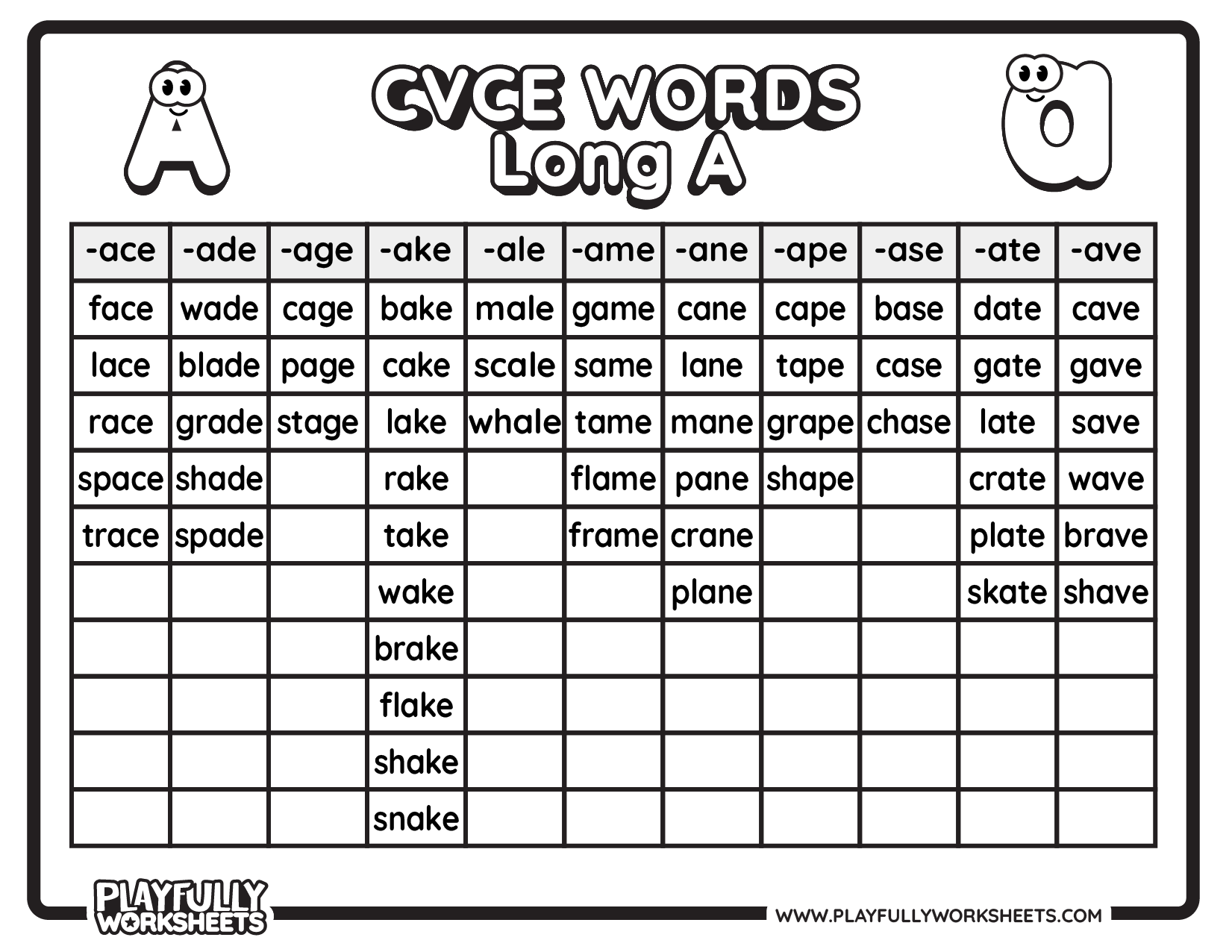
CVCE Long A Word List
-ace: face, lace, race, space, trace
-ade: wade, blade, grade, shade, spade
-age: cage, page, stage
-ake: bake, cake, lake, rake, take, wake, brake, flake, shake, snake
-ale: male, scale, whale
-ame: game, same, tame, flame, frame
-ane: cane, lane, mane, pane, crane, plane
-ape: cape, tape, grape, shape
-ase: base, case, chase
-ate: date, gate, late, crate, plate, skate
-ave: cave, gave, save, wave, brave, shave
Color version
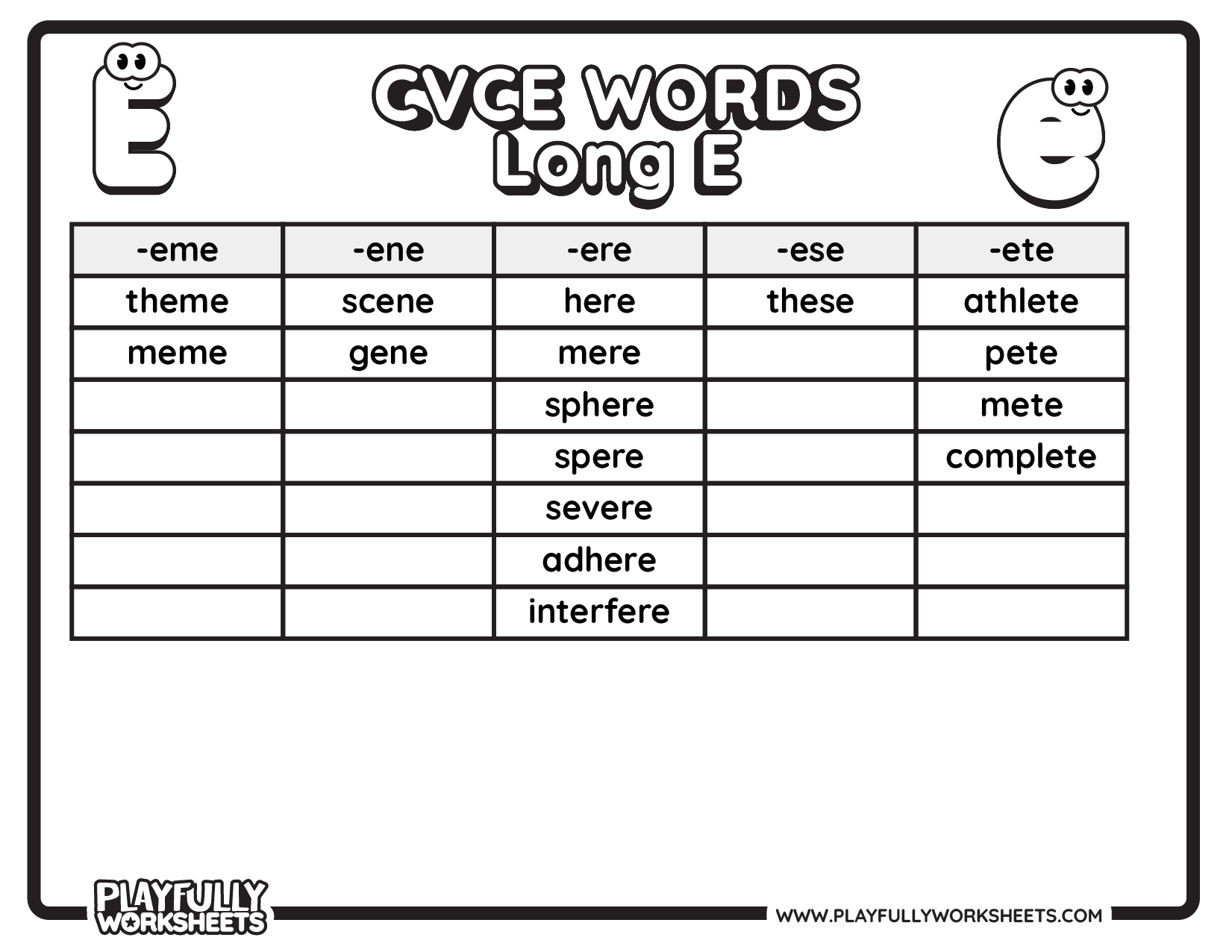
CVCE Long E Word List
It’s important to note that CVCE words with a “long E” sound are less common in English than those with other long vowels. The long “E” sound is more often formed by other vowel patterns, such as “ee” or “ea”
However, there are some words that follow this pattern.
-eme: theme, meme
-ene: scene, gene
-ere: here, mere, sphere, spere, severe, adhere, interfere
-ese: these
-ete: athlete, Pete, mete, complete
Color Version
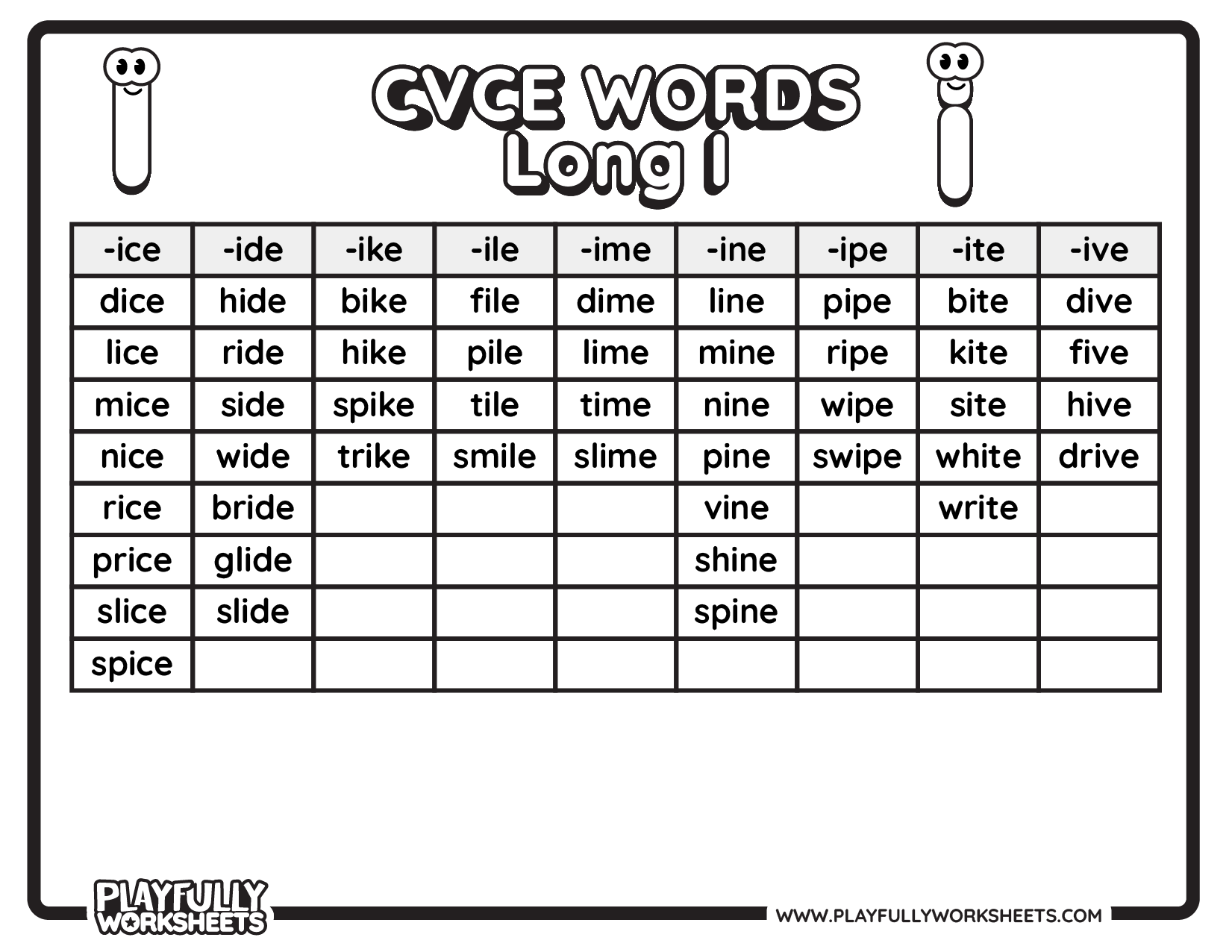
CVCE Long I Word List
-ice: dice, lice, mice, nice, rice, price, slice, spice
-ide: hide, ride, side, wide, bride, glide, slide
-ike: bike, hike, spike, trike
-ile: file, pile, tile, smile
-ime: dime, lime, time, slime
-ine: line, mine, nine, pine, vine, shine, spine
-ipe: pipe, ripe, wipe, swipe
-ite: bite, kite, site, white, write
-ive: dive, five, hive, drive
Color Version
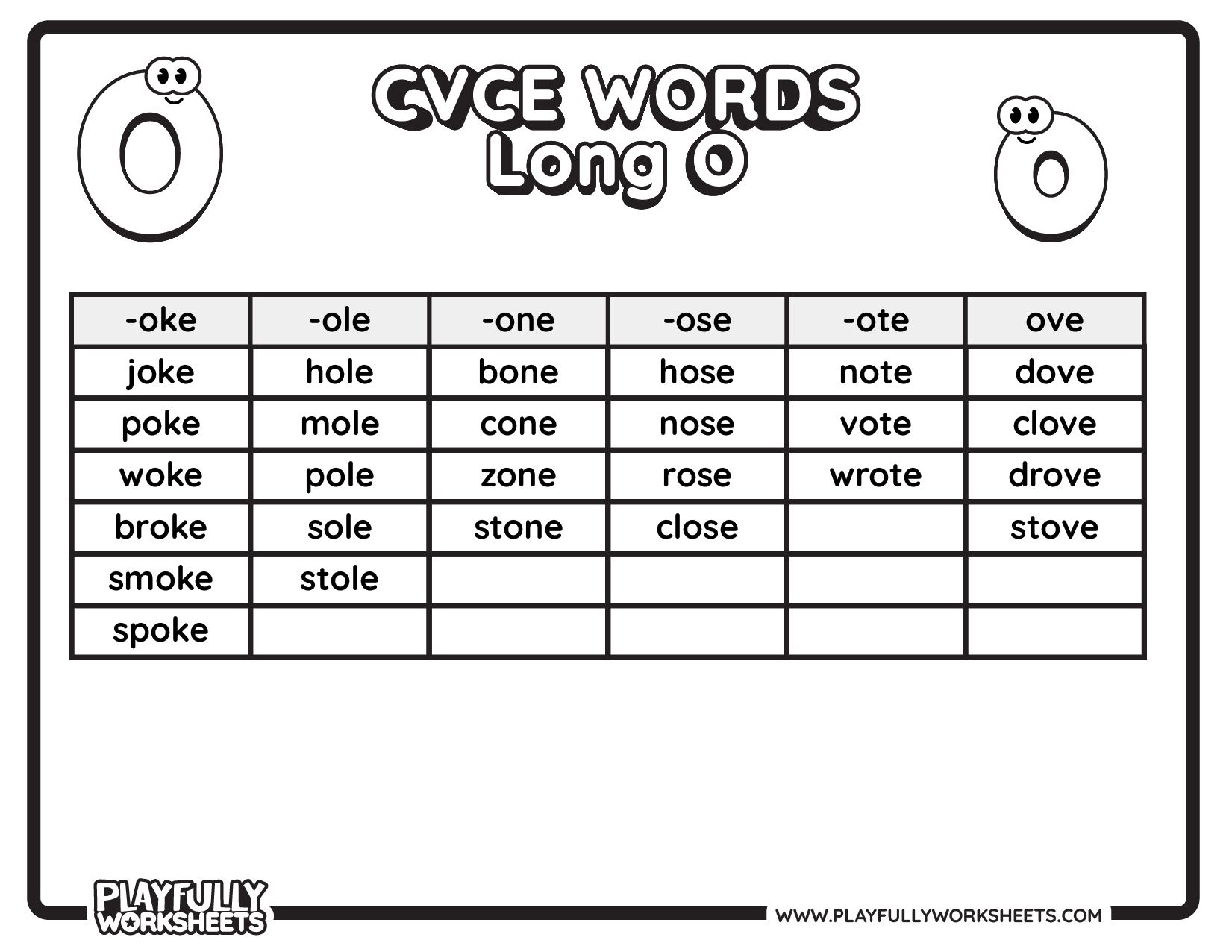
CVCE Long O Word List
-oke: joke, poke, woke, broke, smoke, spoke
-ole: hole, mole, pole, sole, stole
-one: bone, cone, zone, stone
-ose: hose, nose, rose, close
-ote: note, vote, wrote
-ove: dove, clove, drove, stove
Color Version
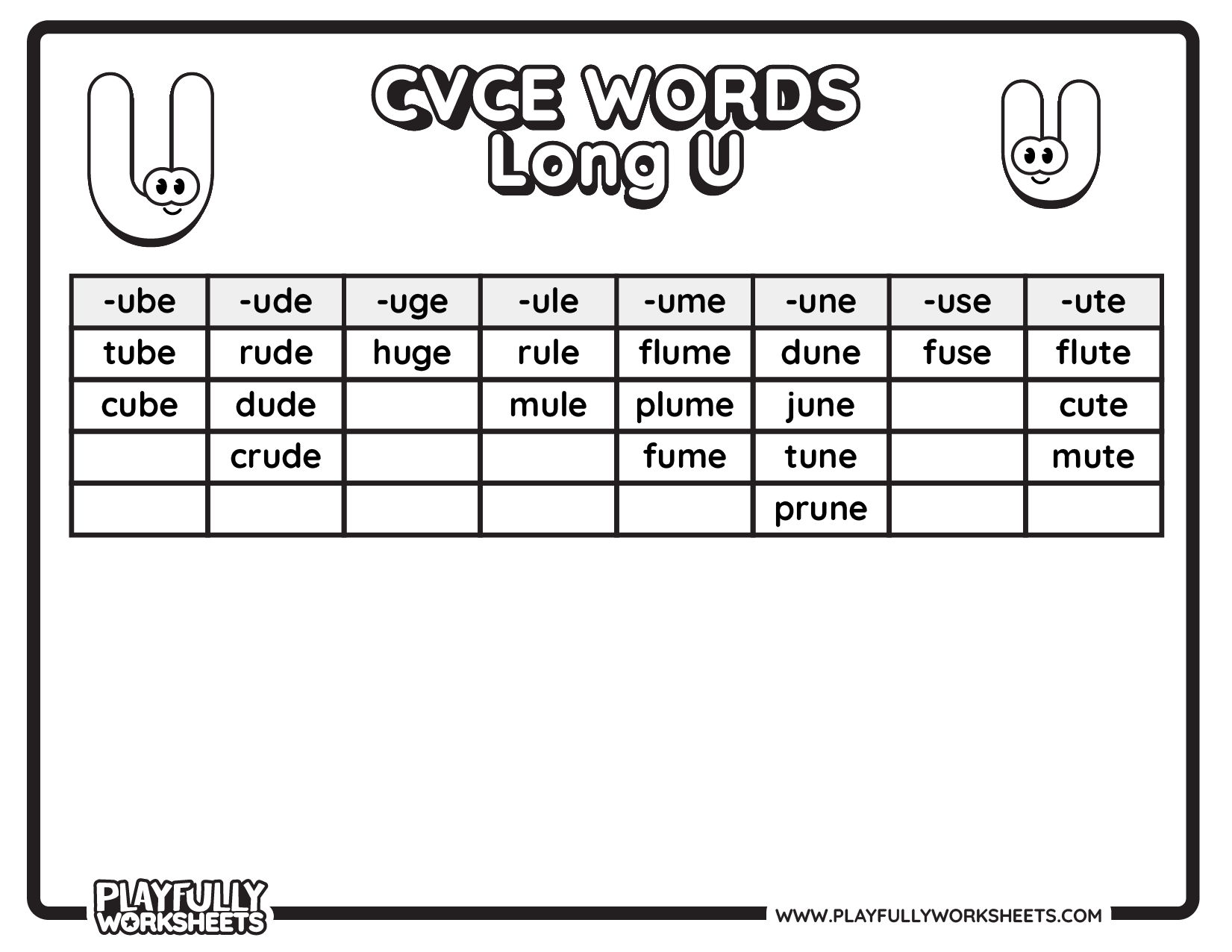
CVCE Long U Word List
-ube: tube, cube
-ude: rude, dude, crude
-uge: huge
-ule: rule, mule
-ume: flume, plume, fume
-une: dune, June, tune, prune
-use: fuse
-ute: flute, cute, mute
Color Version
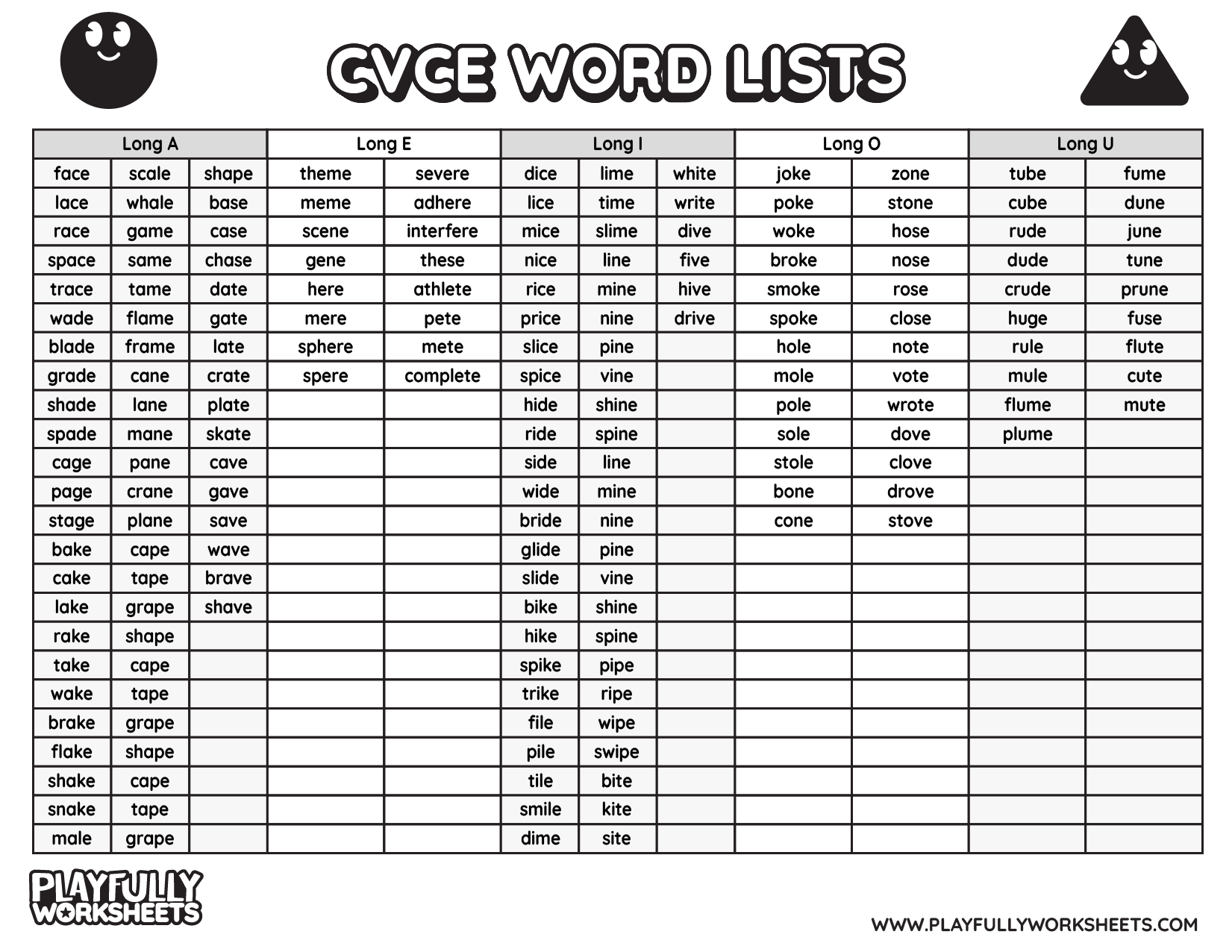
CVCE Word List
Boost early reading skills with this complimentary CVC word list! This printable PDF is an invaluable resource for educators and parents, systematically organizing words by their medial vowel sounds. It’s designed to make learning to read straightforward and effective, whether you’re integrating it into an existing spelling curriculum or using it as a standalone reference for young learners.
Color Version